 Caesar® overview
 From Justinian® to Caesar®
 Law, Justice & Compliance
 Government & Public Administration
 Banking & Financial Services
 Security overview
 On-premise
 Sovereign Cloud
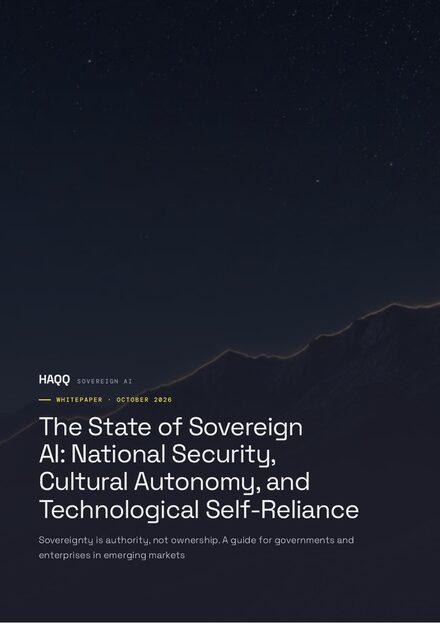 The State of Sovereign AI
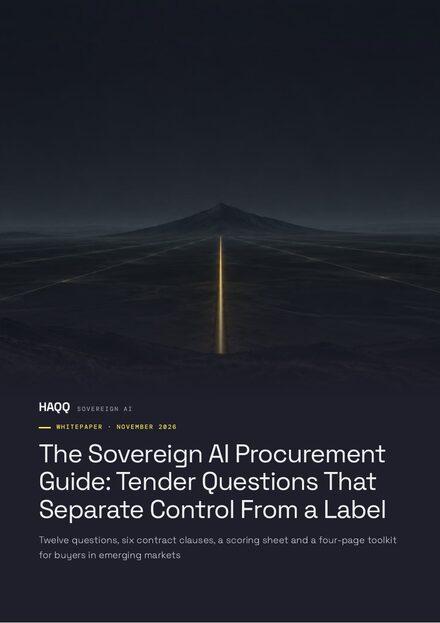 The Sovereign AI Procurement Guide
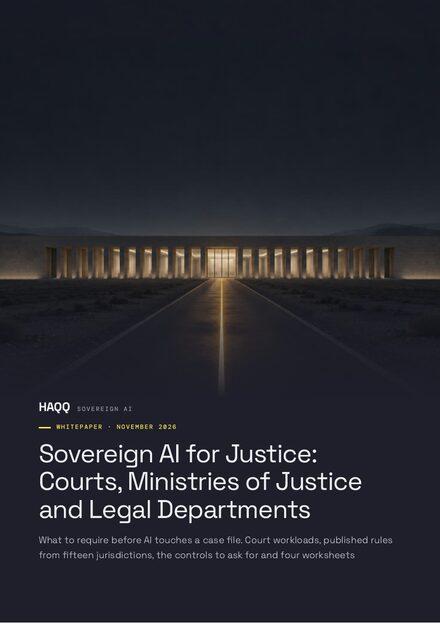 Sovereign AI for Justice
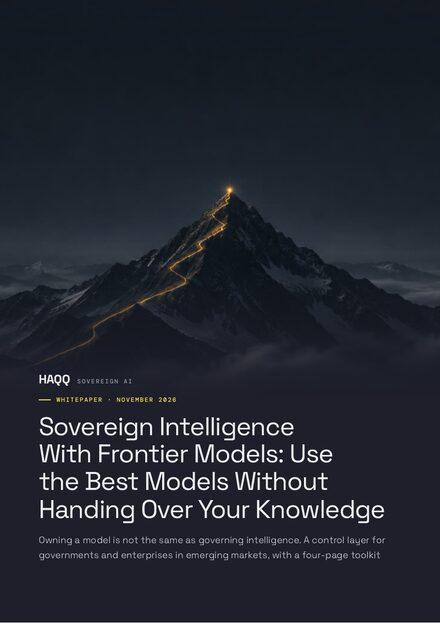 Sovereign Intelligence With Frontier Models
 The Law That Follows Your Data

Sovereign AI for Energy · Powered by Caesar®
Caesar® helps energy teams use the history behind an asset. Retrieve approved technical records, assemble maintenance review material and examine documented obligations, with source references for engineering and commercial reviewers.
No defined use case needed.
You decide what reaches a frontier model.
Decisions draw on plant procedures, maintenance records, supply agreements and operating experience reports. Bring that material into a workflow that keeps the evidence connected to the asset and the question being asked.
For energy producers, utilities, infrastructure owners and energy regulators.
What you could explore with HAQQ
Prepare maintenance reviews
Assemble equipment manuals, maintenance records and open issue records into a briefing for the responsible engineers.
Track commercial obligations
Connect supply agreements, grid connection documents and correspondence to review the obligations that affect the operation.
Recover institutional knowledge
Find earlier decisions and operating experience relevant to the current asset, project or licensing question.
The work, document by document
- Plant procedures
- Technical documentation
- Operating experience reports
Find the record behind a question
A sourced answer with the passages it rests on, for the engineer who asked the question.
- Equipment manuals
- Maintenance records
- Open issue records
Prepare a maintenance review
A briefing of the asset’s service history and recorded open issues, for the responsible engineers to review.
- Operating logs
- Procedure documents
- Report template
Draft an internal operations report
A first-draft report in the standard template, with a summary and sources, for the author to correct.
- Licensing application
- Previous decisions
- Regulatory guidance
Research precedent for a licensing review
A summary of earlier decisions on the same question, with references, for the reviewer who keeps the judgment.
- Supply agreement
- Project documents
- Correspondence
Check obligations in a supply agreement
A list of the obligations and dates recorded in each document, tied to its clause, for commercial reviewers.
Illustrative possibilities, not live deployments. Sources, integrations and review steps are agreed with your team before any work begins.
Talk to HAQQ →In the field
See where energy operators keep AI inside the fence.
From South Korea to California, nuclear operators, national oil companies and state generators are putting language models to work on decades of plant records. Several host the work on their own sites and in their own data centers, and say security is the reason.
A nuclear plant operator
Contracted a generative AI platform for nuclear power, trained on its plant operating experience and procedure documents. The infrastructure is installed in the operator’s own data center and the model is trained only within a closed network.
Public source↗40+years of plant operating data
An electric and gas utility
Is deploying generative AI document search for staff at a two-unit nuclear plant, using character recognition and retrieval over the plant’s technical documentation. The system is installed on site at the plant.
Public source↗A national oil company
Says it develops its own models with its own data. An industrial large language model, trained on decades of the company’s proprietary data, now serves its business.
Public source↗A nuclear fleet operator
Announced a partnership for conversational agents that query the technical memory of its nuclear fleet. The data is to be hosted on a sovereign cloud or in its own data centers, and the tools will not concern plant control systems.
Public source↗5years, length of the partnership
A state-owned power generator
Released a large model for power generation, deployed in safety and environmental protection, electricity trading, production dispatching and equipment maintenance. The source describes it as built entirely on domestic technologies.
Public source↗13scenarios already deployed
Independent examples from the public record, each linked to its source. None of these institutions is a HAQQ customer and HAQQ took no part in their work. They show where the sector is already going.
The rules behind it
European Union, energy as a sector of high criticality
NIS 2 Directive, Directive (EU) 2022/2555
Entities take cybersecurity risk-management measures that include supply chain security and the security of their relationships with direct suppliers and service providers.
Official text↗North America, bulk electric system
NERC CIP-011-3, Information Protection
Sets information protection requirements to prevent unauthorized access to information about the cyber systems of the bulk electric system.
Official text↗European Union, Annex III
AI Act, Regulation (EU) 2024/1689
AI systems used as safety components in the supply of gas, heating or electricity are classed as high-risk.
Official text↗The architecture
Own every layer of your Sovereign AI.
Caesar® is the whole architecture. It wraps every layer of the chain in sovereignty, from the energy and hardware it runs on to your data, its intelligence and the applications your people use.
Illustrative example
“Prepare a review brief for this asset using its approved maintenance history, manuals and unresolved issue records.”
Illustrative example, not a live system response. The result depends on the connected sources and agreed configuration.
For energy ministries, energy and water regulators, utilities and energy operators.
This requestAsked in the HAQQ web workspace. Only the regulatory team can open this connection file.
SovereignYour people work in HAQQ’s apps or your own, under your access rules.
Statutes, codes, guidance and asset history, structured for the engine.
This requestAsset manuals, approved service and issue records and review instructions.
SovereignYou decide what reaches a frontier model.
Checks, reasons and governs every request.
Model examples. Enabled integrations and API credential options are defined for your deployment.
This requestCaesar® resolves the context, selects the tools and applies the permitted model policy before generation begins. Routed to an open-weight model, self-hosted.
SovereignCaesar® routes each task to the models you approve, and you can bring your own API key.
Where data and compute sit.
This requestOn premises.
SovereignCaesar® runs in Sovereign Cloud or on your own infrastructure.
The power behind every deployment.
SovereignYour deployment runs on the power of the site you choose.
What this example would deliver
- An asset history with source references
- A list of recorded open issues
- Questions for the responsible engineering team
Where it runs
Deploy Caesar® where your jurisdiction requires.
In Sovereign Cloud or on your own infrastructure.
Deployment
Choose where your Sovereign AI runs.
Sovereignty means deciding where information is stored and processed, who can use it and whether a request may reach an outside model. Choose the environment for Caesar® and set those rules before the work begins.

HAQQ manages the hosting environment. Agree on the region, data handling and permitted models as part of the deployment.
- Upfront
- No hardware or setup to fund
- Best for
- The fastest start

Run Caesar® on your own infrastructure. Use locally hosted models for work that must stay inside the boundary, with external calls enabled only where permitted.
- Upfront
- Hardware you buy and own
- Best for
- Full control of data and compute
API and MCP · Early access
Connect through the APIAn API lets your software send a task to Caesar® and receive the result. Your developers can put research, document comparison or drafting inside the application your team uses.
Hosting and model access are separate choices. A locally hosted engine can use local models, permitted external models, or a combination agreed for the deployment.
Earn your regulators’ trust with security built in.
Caesar® is built to the security and AI-governance standards regulators expect, and every call is logged for audit.
Understand the engine behind every industry.





















Get answers on deploying Caesar® in your institution.
Who is Caesar® for?
Governments and enterprises in sovereign industries: ministries, regulators, banks, public authorities and enterprises, across 25 industries.
Do we need a defined AI use case to start?
No. We work through it with your team, then the architecture, infrastructure, security review and deployment path your environment requires.
Can Caesar® work with the data room or document store we already run?
Yes. Caesar® connects to document stores, databases and enterprise software through their available interfaces, and you define what each connection can read or change.
Can we start in Sovereign Cloud and move on premise later?
Yes. A deployment can start with one task in Sovereign Cloud and move to Hybrid or On-premise as your rules and volumes require. Your knowledge map, connections and workflow rules stay in the engine.
Do we have to buy hardware?
It depends on the set-up. Sovereign Cloud: no hardware or setup to fund. Hybrid: hardware for what stays on site. On-premise: hardware you buy and own.
Who stays responsible for decisions?
Your people. Caesar® prepares the work; your team reviews it and makes the call. You define who reviews, who approves and what may proceed after approval.
Who runs Caesar® day to day: our team or HAQQ?
Your team, HAQQ, or both. Your institution agrees internal ownership and escalation; HAQQ agrees support, monitoring and maintenance responsibilities, written for each deployment.
How long does a deployment take?
It depends on the set-up and on your approvals. Sovereign Cloud is the fastest start, with no hardware to fund; an on-premise deployment follows your hardware lead times. We start with one task and a reviewer who knows the work, then expand.
Does Caesar® know our country’s laws and regulations?
Caesar®’s data layer structures laws, regulations and your own documents for the engine, and it applies the right language, jurisdiction or domain framework to each request. You can also connect the reference content you maintain, such as your own circulars.
Continue from here.

Bring an asset whose history is hard to find.
We’ll map the sources and review process for a first energy workflow.
Talk to HAQQBring the problem and we’ll shape the use case with you.
You don’t need a defined AI use case to start. We work through it with your team, then the architecture, infrastructure, security review and deployment path your environment requires.
Prefer email? Write to our team