 Caesar® overview
 From Justinian® to Caesar®
 Law, Justice & Compliance
 Government & Public Administration
 Banking & Financial Services
 Security overview
 On-premise
 Sovereign Cloud
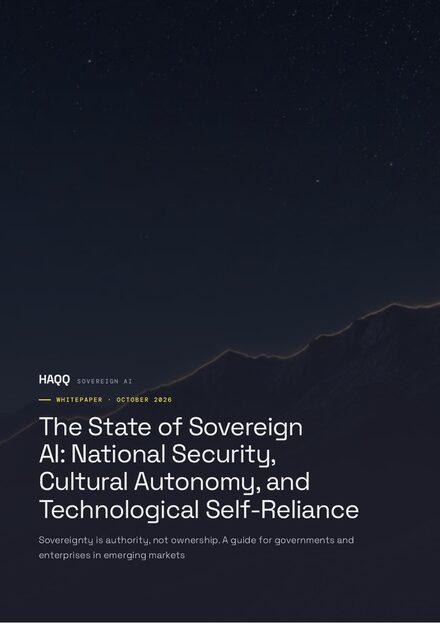 The State of Sovereign AI
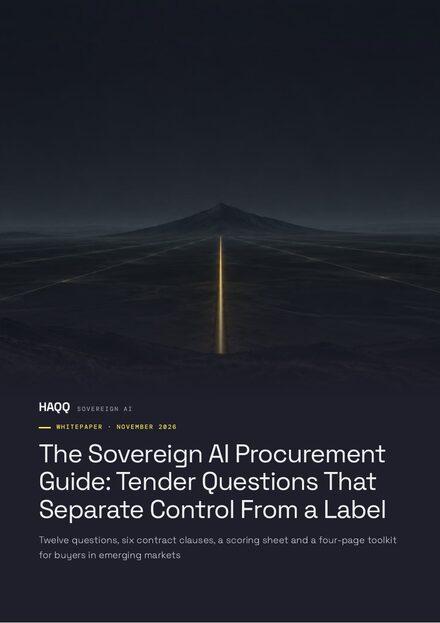 The Sovereign AI Procurement Guide
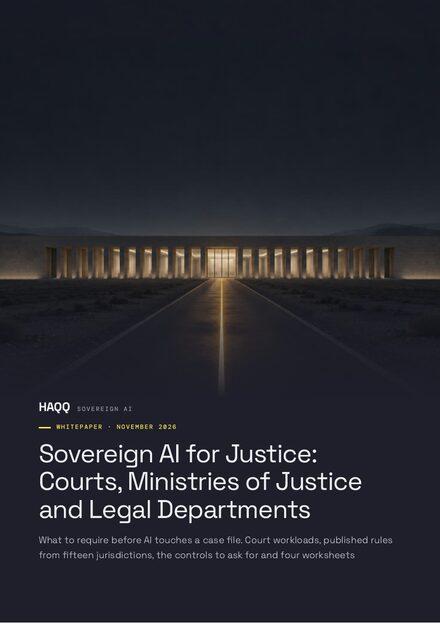 Sovereign AI for Justice
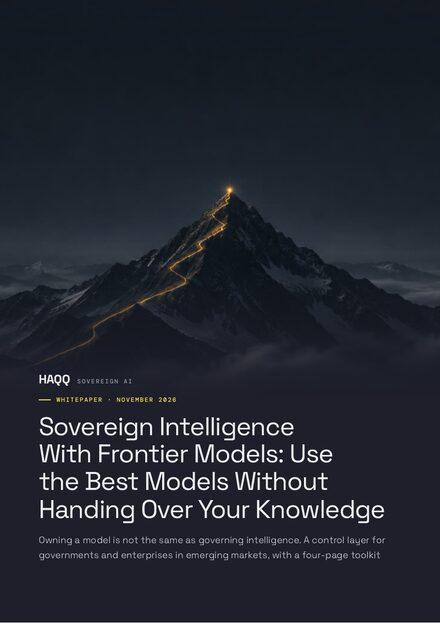 Sovereign Intelligence With Frontier Models
 The Law That Follows Your Data

Sovereign AI for Water · Powered by Caesar®
Caesar® helps water and sanitation teams prepare reviews from the records they already hold. Bring inspection findings, plant procedures and recorded responses together, identify missing evidence and produce a briefing for qualified operations staff.
No defined use case needed.
You decide what reaches a frontier model.
The records of an issue can span a treatment plant, a contractor’s reports and several logging systems. Bring that history into view for the people responsible for reviewing it.
For water authorities, utilities, desalination plants and wastewater operators.
What you could explore with HAQQ
Prepare operational reviews
Assemble operating logs and inspection reports for a defined plant or network issue.
Organize inspection evidence
Map requested evidence to the available sampling reports, procedures and permit records.
Find the relevant procedure
Retrieve the approved operating procedure for a specified asset or process, with the source and version shown.
The work, document by document
- Inspection reports
- Operating logs
- Plant procedures
Prepare a plant review
A source-linked chronology of the issue and its recorded responses, for qualified operations staff to review.
- Inspection request
- Sampling reports
- Standard operating procedures
Map evidence to an inspection request
An index showing which record answers each requested item, and which items still lack evidence.
- Risk and resilience assessment
- Emergency response plan
- Regulatory checklist
Check a risk and resilience assessment
A list of required sections that are missing or incomplete, for the compliance team to confirm.
- Internal regulations
- Technical publications
- Past reports
Answer from the utility’s own documents
A sourced answer that shows the document and version behind each statement, for the employee who asked.
- Treatment procedure
- Technical standard
- Permit conditions
Compare a procedure with a standard
A point-by-point comparison with the differences marked, for quality staff to assess.
Illustrative possibilities, not live deployments. Sources, integrations and review steps are agreed with your team before any work begins.
Talk to HAQQ →In the field
See how water bodies keep AI close to the source.
Water has fewer public examples than other sectors, and several are pilots. The clearest, from South Korea to the Netherlands, answer staff questions from the organization’s own documents and say where the model runs.
A national water corporation
Opened a generative AI assistant for staff that answers from the corporation’s internal documents and shows the source for each answer. A lightweight language model was built internally to prevent information leakage.
Public source↗94%answer accuracy reported in testing
A water knowledge center
Runs an AI search assistant that answers water managers’ questions from its publications, with a downloadable source. The code sits on a partner body’s developer platform, the model runs in a data center in Sweden and conversations are not stored.
Public source↗A provincial water research institute
Deployed an open-source language model locally, described as a “smart brain” for the water industry. The same report describes water authorities elsewhere in the country using such models for a knowledge base and flood scheduling.
Public source↗A regulated water utility
Is piloting an AI system to predict asset failures from supply network sensor data. The utility says it would prefer an on-premises language model to a public one.
Public source↗
Independent examples from the public record, each linked to its source. None of these institutions is a HAQQ customer and HAQQ took no part in their work. They show where the sector is already going.
The rules behind it
European Union, drinking water and waste water
NIS 2 Directive, Directive (EU) 2022/2555
Entities take cybersecurity risk-management measures that include supply chain security and the security of their relationships with direct suppliers and service providers.
Official text↗European Union, drinking water and waste water
Critical Entities Resilience Directive, Directive (EU) 2022/2557
Critical entities take appropriate and proportionate technical, security and organizational measures to ensure their resilience.
Official text↗European Union, Annex III
AI Act, Regulation (EU) 2024/1689
AI systems used as safety components in the supply of water are classed as high-risk.
Official text↗The architecture
Own every layer of your Sovereign AI.
Caesar® is the whole architecture. It wraps every layer of the chain in sovereignty, from the energy and hardware it runs on to your data, its intelligence and the applications your people use.
Illustrative example
“Prepare the documentation for this plant review. Bring together the inspection history, approved procedures and open findings.”
Illustrative example, not a live system response. The result depends on the connected sources and agreed configuration.
For water authorities, utilities, desalination operators, wastewater operators and sanitation regulators.
This requestAsked in the HAQQ web workspace. Only the compliance team can open this permit file.
SovereignYour people work in HAQQ’s apps or your own, under your access rules.
Statutes, standards, guidance and asset history, structured for the engine.
This requestInspection reports, approved plant procedures and open findings and recorded responses.
SovereignYou decide what reaches a frontier model.
Checks, reasons and governs every request.
Model examples. Enabled integrations and API credential options are defined for your deployment.
This requestCaesar® resolves the context, selects the tools and applies the permitted model policy before generation begins. Routed to a frontier model.
SovereignCaesar® routes each task to the models you approve, and you can bring your own API key.
Where data and compute sit.
This requestSovereign Cloud.
SovereignCaesar® runs in Sovereign Cloud or on your own infrastructure.
The power behind every deployment.
SovereignYour deployment runs on the power of the site you choose.
What this example would deliver
- A source-linked review chronology
- An evidence index for the review team
- Unresolved findings and missing records
Where it runs
Deploy Caesar® where your jurisdiction requires.
In Sovereign Cloud or on your own infrastructure.
Deployment
Choose where your Sovereign AI runs.
Sovereignty means deciding where information is stored and processed, who can use it and whether a request may reach an outside model. Choose the environment for Caesar® and set those rules before the work begins.

HAQQ manages the hosting environment. Agree on the region, data handling and permitted models as part of the deployment.
- Upfront
- No hardware or setup to fund
- Best for
- The fastest start

Run Caesar® on your own infrastructure. Use locally hosted models for work that must stay inside the boundary, with external calls enabled only where permitted.
- Upfront
- Hardware you buy and own
- Best for
- Full control of data and compute
API and MCP · Early access
Connect through the APIAn API lets your software send a task to Caesar® and receive the result. Your developers can put research, document comparison or drafting inside the application your team uses.
Hosting and model access are separate choices. A locally hosted engine can use local models, permitted external models, or a combination agreed for the deployment.
Earn your regulators’ trust with security built in.
Caesar® is built to the security and AI-governance standards regulators expect, and every call is logged for audit.
Understand the engine behind every industry.





















Get answers on deploying Caesar® in your institution.
Who is Caesar® for?
Governments and enterprises in sovereign industries: ministries, regulators, banks, public authorities and enterprises, across 25 industries.
Do we need a defined AI use case to start?
No. We work through it with your team, then the architecture, infrastructure, security review and deployment path your environment requires.
Can Caesar® work with the data room or document store we already run?
Yes. Caesar® connects to document stores, databases and enterprise software through their available interfaces, and you define what each connection can read or change.
Can we start in Sovereign Cloud and move on premise later?
Yes. A deployment can start with one task in Sovereign Cloud and move to Hybrid or On-premise as your rules and volumes require. Your knowledge map, connections and workflow rules stay in the engine.
Do we have to buy hardware?
It depends on the set-up. Sovereign Cloud: no hardware or setup to fund. Hybrid: hardware for what stays on site. On-premise: hardware you buy and own.
Who stays responsible for decisions?
Your people. Caesar® prepares the work; your team reviews it and makes the call. You define who reviews, who approves and what may proceed after approval.
Who runs Caesar® day to day: our team or HAQQ?
Your team, HAQQ, or both. Your institution agrees internal ownership and escalation; HAQQ agrees support, monitoring and maintenance responsibilities, written for each deployment.
How long does a deployment take?
It depends on the set-up and on your approvals. Sovereign Cloud is the fastest start, with no hardware to fund; an on-premise deployment follows your hardware lead times. We start with one task and a reviewer who knows the work, then expand.
Does Caesar® know our country’s laws and regulations?
Caesar®’s data layer structures laws, regulations and your own documents for the engine, and it applies the right language, jurisdiction or domain framework to each request. You can also connect the reference content you maintain, such as your own circulars.
Continue from here.

Bring the records behind one recurring problem.
We’ll scope a workflow around the information your water or sanitation teams already use.
Talk to HAQQBring the problem and we’ll shape the use case with you.
You don’t need a defined AI use case to start. We work through it with your team, then the architecture, infrastructure, security review and deployment path your environment requires.
Prefer email? Write to our team